Dispatch · Saturday, July 24, 2021
Sparkling Wine 101: Pét-Nat, Traditional Method and More
Billionaires racing to space lead into a primer on bubbles: how sparkling began as a mistake, and how pét-nat differs from traditional method.
{{ snippet.ovc-forward }}
Two weeks ago, Richard Branson went up into space. Earlier this week Jeff Bezos followed suit. I adore how SpaceX, Virgin, and Blue Origin are privatizing space exploration while pushing the human race to other planets.
Say what you will about Elon Musk, but I feel he is continually pushing the boundaries to us to Mars. It makes me wonder if Elon is the reason for the “Billionaire race to space?” Competition is always good, and I will keep this short and sweet. SpaceX is in a different league than Virgin and Blue Origin, but if I were to blow an absolute crap ton of money for a space trip, I feel Virgin is the route to go. Watching the event with my daughter today, we discussed the differences between the two expeditions. Virgin gives the presence of a “normal-ish” plane ride to space, including the touchdown. Blue Origin is a rocket ship blasting into space while the help of parachutes on the trek back to Earth’s surface at 15 mph. I will admit I haven’t been following the long-term mission for Blue Origin, and maybe they are looking to get us to Mars like SpaceX. But, purely from a consumer perspective, give me Virgin’s experience any day!
As I mentioned, I am glad to see the human race moving forward in space exploration once again. I am hopeful to see the depths of space in my lifetime, and when I land on the moon, do you know what I am doing? I am popping a bottle of Bubbles!
When I started the newsletter, my intent all along was to share my journey through wine country. Week in and week out, I am engrossed in my adventures while learning so much along the way. I enjoy getting emails every week from you saying how you appreciated the newsletter. It gives me fuel for the next week. I am going to do something a tad bit different this week. It’s still all about learning and part of my journey through wine country, but (yes, there is ALWAYS a but) I want to share what I have absorbed over the last several months regarding Sparkling. If you are an expert in all things Sparkling, aka Bubbles, aka Champagne, here is your get out of jail for free card. Have a great weekend, and I will see you next week!
If you are still here, thank you for sticking around! Shall we begin?
Since you are reading the newsletter, I can safely assume you enjoy wine, or you are a close friend supporting my wine habit while being a cheerleader on the sideline cheering me on. We all know wine is a social glue. It brings people together in times of happiness and sorrow. Add in CO2, sugar, and a heck of a lot of patience to the mix, and now we have a representation of good happy times. Sparkling symbolizes celebrations at Super Bowls, the World Series, New Years, and countless other events. We are programmed to be giddy about Bubbles, and it doesn’t bother me one bit!
Did you realize the addition of bubbles to still wine was a mistake? The "accident" was the wine was added to the bottle before it was done fermenting. As a result, corks would blow out of the bottles. These bottles were called le vin du diable, “the devil's wine.” Eventually, muselets, wire cages were created and paved the path for what we call Methode champenoise, Methode Traditionnelle, Sparkling wines. In addition, you might see Methode Cremate, which is precisely like Methode Champenoise, but not from the Champagne region. One other method of Sparkling production to note is Methode Ancentrisal, pet nat. The difference between the two is all about second fermentation. Pet Nat, the triage during second fermentation is left in the bottle giving the wine a hazy look to it. Traditionnelle, the triage is riddled to the bottle's neck where it is frozen and disgorged from the bottle. Typically, you can tell the difference from looking at the bottle caps. Pet Nat typically has a cap on the bottle, and Traditionnelle has a cage around its cork.
All of us are aware Pinot is King and Chardonnay is Queen in Oregon. I also assume you are aware of the similar climates between Burgundy and the Willamette Valley. Did you also know the weather in Champagne is also similar to our wonderful Willamette Valley? A majority of the great Champagnes comprise of Pinot (Blanc de Noir) and Chardonnay (Blanc de Blanc). Are you learning anything yet?
 |
For me, the next big question is if we produce killer Pinots and Chards, why don’t more Oregon wineries produce Sparkling? Let’s think through the process a bit. As a winery, you have to be super crazy patient on top of your already patient timeline of producing still wines. Let’s say you are making a Blanc de Noir. Harvest for Sparkling starts 3-4 weeks before the expected harvest, so the sugar levels, aka brix, are lower. After harvest, first fermentation occurs, followed by adding triage for secondary fermentation in the bottle. The first fermentation timeline depends on what the winemaker wants to achieve with barrel. Secondary fermentation takes 6-8 weeks before disgorging occurs, where it is corked and caged to age even more for a fantastic bubbly experience.
Outside of extreme patience, special equipment is needed to disgorge and not to mention the triage. Luckily for us, Andrew Rich of Radiant Sparkling Wine Company provides the equipment and consulting services to ensure the best Sparkling Wine possible. Diving deeper and deeper into Oregon Sparkling, the number of wineries using Andrew Davis’s equipment and services is impressive to me. It feels like Radiant Sparkling is the nucleus of Oregon Sparkling.
Andrew’s Oregon journey started with Argyle. He was there for seven years. When he left, he desired to continue on the Sparkling path. As he began to consult, wineries wanted to create Sparkling, but a lack of resources, aka no equipment/knowledge, presented roadblocks. Looking at similar models in Champagne and California, Andrew compiled a business plan for a loan. The first year Andrew had eight producers, and the second year exceeded his business plan. The demand for bubbles exceeded Andrew’s expectation and was lucky enough to deliver on a need. In 20-30 years, Andrew's goal is to have Oregon become the New World icon for Sparkling.
In my research so far, I found 42 different producers of Oregon Sparkling. Most are in the Valley, but there is one producer Maison Jussiame in Southern Oregon knocking it out of the ballpark. Sunset magazine had a recent wine competition, Sunset International Wine Competition, and the 2019 Oeil de Perdrix, Partridge's eyes, a Cuvee of 50/50 Pinot and Chardonnay, from Maison Jussiaume went home with Best Sparkling Award. Also, if you were paying attention to last week’s newsletter, Domaine Serene’s Rose Brut scored 96, and their Brut scored 95 at Decanter’s World Wine Awards. It’s enthralling to see Oregon getting on the map for Sparkling. I can’t wait to see where it takes us.
Real quick, glassware for Sparkling. If you want to drink bubbles for the sake of drinking bubbles, flutes are the way to go. However, if you're going to get a little nerdy, don’t use a flute. Flutes don’t allow you the ability to do a proper sniffy sniff. I like the Riedel Champagne glasses, but if you don’t want to spend the money, a nice universal glass or a Chardonnay glass will get you great results.
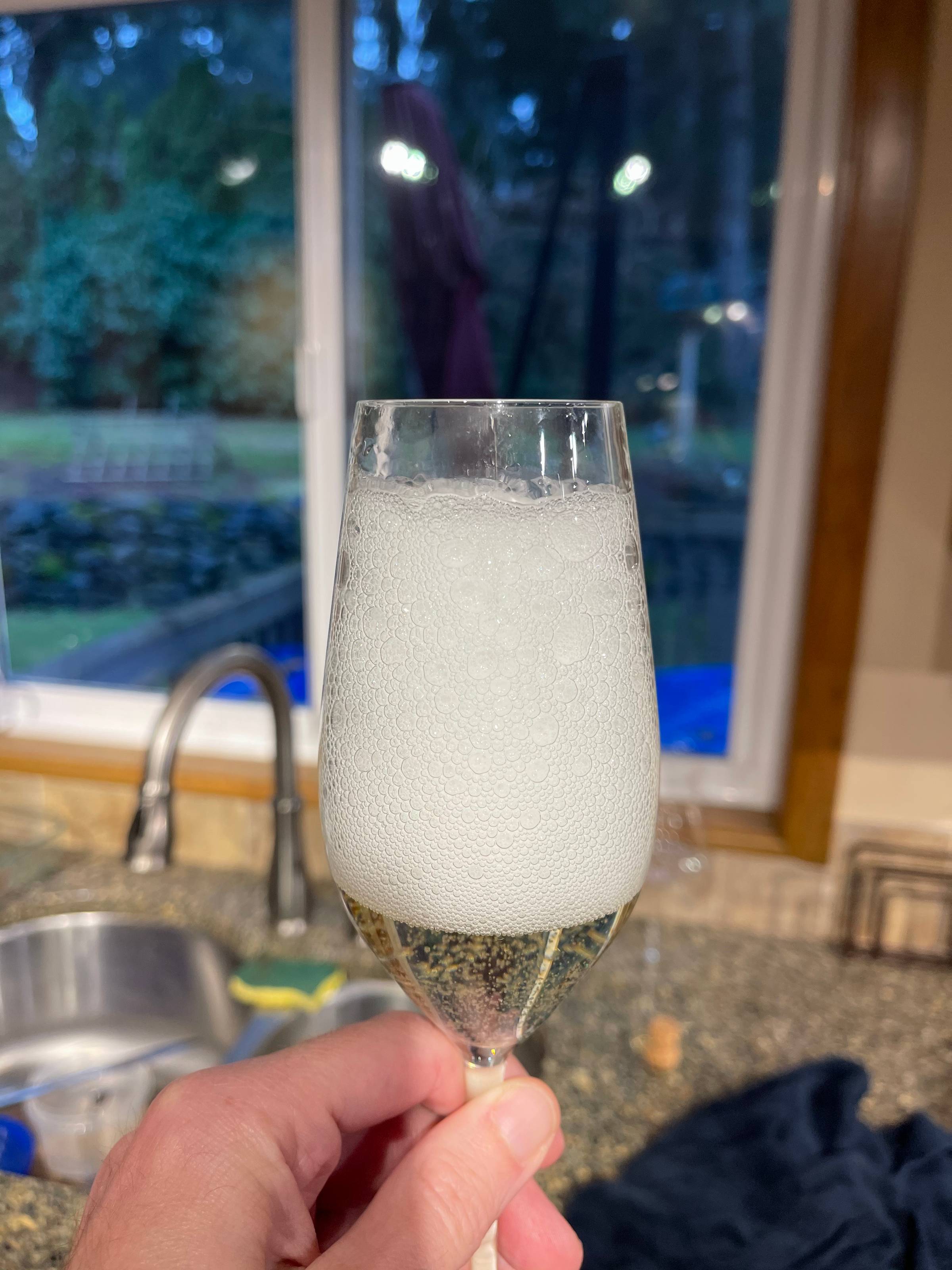 |
I will bore you to death with one more little tidbit I learned during my Sparkling journey, and it is the term mousse. Before I get into mousse, there is a little thing to know while tasting Sparkling. Do not swirl like a Pinot or Chard. You do not want to wreck the bubbles. Mousse is all about the bubbles while describing the foam once it is in your glass. But, it doesn’t stop there. Once the foam has soothed down a bit, notice how bubbles continue to escape to the top of the glass. If there are enough bubbles, you will see a thin layer of mousse across the top of the wine. Mousse is also used to describe mouthfeel. The tinier the bubbles, the more sensation is felt across your mid-palate.
Sparkling is such an excellent rabbit hole to explore the many depths of wine. I am curious what Oregon Sparkling have you enjoyed? Was there an occasion you opened the bottle or was it just a Tuesday night kind of thing?
With Gratitude,
A.J.
PS - What did you think of the newsletter this week?
{{ snippet.shameless-book-plug }}
A.J. Weinzettel
Wine journalist & podcaster covering Oregon wine country